
Our Research
Omni Med offers unique opportunities for students, faculty, and researchers to engage in community-based research that addresses real health challenges in Mukono District, Uganda. Our research initiatives are designed to build on existing collaborations, with a focus on generating knowledge that can improve health outcomes for rural communities.
Working alongside our experienced Ugandan staff and Village Health Teams, researchers gain valuable insights into the local context while contributing to sustainable health solutions. All research projects are developed in partnership with community stakeholders to ensure they address local priorities and respect cultural contexts.
The Research Process
Please keep in mind that research takes significant time and resources. We do not hold out the possibility that students can come in and execute a research project in just one or two months. Most of the studies we have executed and published, as well as ones ongoing now, take months to years to complete.
-
Developing a research question and study outline
-
Drafting and submitting an IRB application (~$350)
-
Obtaining approval from the Uganda National Council for Science and Technology (~$350)
-
Executing the study (questionnaire, RCT, or other design)
-
Analyzing data and publishing results ($500–$4000 in publication fees)
-
From initial design to publication often takes 1-2 years.
The above is not meant to discourage anyone from considering research in Uganda. Rather, it is intended to give a real-world perspective on just how challenging it is to execute well. Most of the students who have worked on various trials with us have played significant but relatively minor roles in the process, mainly due to time constraints; most are only with us in Makata for one month. However, most students working with us will have the opportunity to fully understand the process of how we conduct research, and many will play roles in preparation, pilot studies, data collection, or analysis. We strongly believe in studying the impact of what we do and we welcome students to our research team. But we also want students to come in with realistic expectations.
Supporting and retaining Village Health Teams: an assessment of a community health worker program in two Ugandan districts

The use of low-cost ruggedized Android tablets to augment in-service training of community health workers in Mukono, Uganda: perspectives and lessons learned from the field

The use of low-cost Android tablets to train community health workers in Mukono, Uganda, in the recognition, treatment and prevention of pneumonia in children under five: a pilot randomised controlled trial

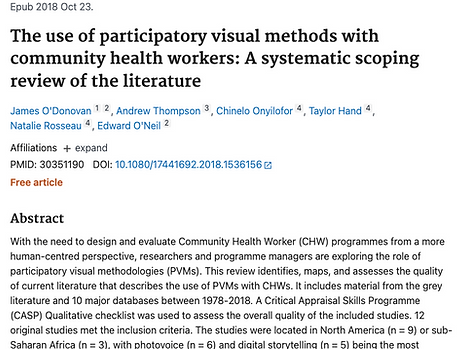
Potential challenges of implementing the Community Health Extension Worker programme in Uganda

ONGOING PROJECT:
Community Mental Health and the Role of Village Health Teams in Uganda: Challenges, Intervention
Acceptability, and Sustainability in Mukono District:
A Case Study of Omni Med Uganda
Current & Ongoing Research

Cervical Cancer: Identifying Barriers and Beliefs to HPV Vaccination
Objective:Identify the barriers and facilitators VHTs face in HPV vaccination promotion, to improve uptake and reduce cervical cancer burden in Uganda.
-
Cervical cancer is the leading cause of cancer-related deaths in Uganda.
-
HPV vaccination uptake remains suboptimal.
-
VHTs (Village Health Team members) are key in promoting health education, yet face barriers in encouraging vaccination.
Omni Med is committed to pairing service delivery with research and innovation. We welcome collaboration with researchers, educators, and global health partners.